Kino's Knife
Kino's Knife is a recurring object in John Steinbeck's novella The Pearl, a tool that evolves from a practical implement of daily labor into a weapon of violence and a marker of Kino's moral transformation. Initially used for opening oysters and cutting food, the knife becomes central to the escalating conflict that the great pearl brings, ultimately serving as the instrument by which Kino kills a man and as a symbol of the irreversible loss of his former innocence.
Identity and Practical Origins
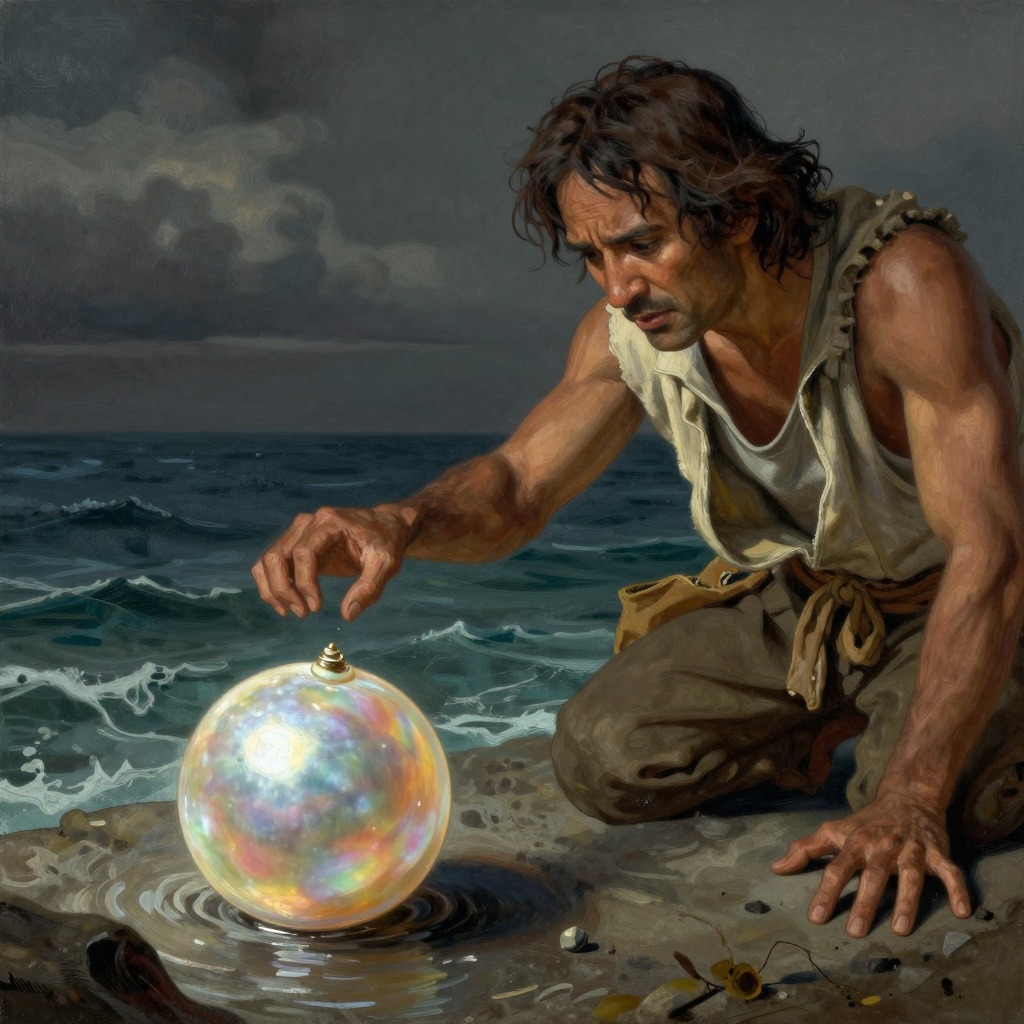
Kino's knife first appears in the context of his work as a pearl diver. When Kino opens the great oyster that contains the Pearl of the World, he uses his "short strong knife" to cut the muscle and pry the shell apart . At this stage, the knife is a neutral, functional object, part of the fisherman's everyday equipment, no more remarkable than his diving rock or his basket. It is the tool of a man who lives by his hands, and its use in opening the oyster is a routine act that becomes extraordinary only because of what it reveals.
Transition to a Weapon
The knife's role shifts dramatically during the second night attack on Kino's house. When an intruder comes to steal the pearl, Kino's hand creeps into his breast where his knife hangs on a string, and he springs "like an angry cat, leaped striking and spitting for the dark thing he knew was in the corner of the house" . He feels cloth, strikes with the knife and misses, then strikes again and feels the blade go through cloth. This is the first time Kino uses the knife as a weapon against another human being, and the act is accompanied by a wild rage that surges in him. After the attacker flees, Kino raises the blade and sees a little line of blood on the steel, then plunges the knife into the earth to cleanse it . The gesture is both practical and symbolic: he tries to purify the tool, but the blood on it foreshadows the violence to come.
The Big Working Knife as a Tool of Survival
After Kino's brush house is burned and his canoe destroyed, his brother Juan Tomás provides him with a new, larger blade: "a long working knife, eighteen inches long and heavy, as a small ax, a tool and a weapon" . When Kino sees this knife, his eyes light up, and he fondles the blade and tests its edge with his thumb. This knife is explicitly described as both a tool and a weapon, reflecting the dual role it will play in the family's flight. It is a practical implement for cutting and survival, but also a means of defense in a world that has become hostile. Kino carries it constantly, gripping its handle for a sense of protection as he and his family flee into the mountains .
The Knife in the Final Confrontation
In the climactic scene at the mountain pool, Kino strips off his white clothes and hooks his amulet neck-string about the horn handle of the great knife so that it hangs down in front of him, leaving both hands free . He edges down the smooth rock face like a slow lizard, his spread fingers gripping the mountain, his bare toes finding support, and the knife hanging from his back so it will not clash against the stone . When he attacks the trackers, the great knife swings and crunches hollowly, biting through neck and deep into chest . Kino has become "a terrible machine," and the knife is the instrument of his mechanical, efficient violence. He wrenches the knife free and strikes again, killing the seated man. The knife, once a tool for opening oysters, has become an extension of Kino's transformed, animal-like state.
Thematic Significance
The knife's trajectory mirrors Kino's own: from a simple, functional object to a weapon of death. It is a concrete manifestation of the evil that the pearl brings into his life. The blood on the blade after the first attack, the careful way Kino cleanses it by plunging it into the earth, and its final use in killing three men all trace the arc of his moral descent. The knife is not merely a prop but an active participant in the story's violence, a thing that, in the hands of a desperate man, becomes indistinguishable from the man himself. By the end, Kino is no longer a fisherman who uses a knife to open oysters; he is a killer whose knife has become his primary identity.